
“Sis, someone has to go back to try and save those boys…”
— Technical Sergeant (TSgt) James Richard Thomas
Colin Colbourn, Ph.D., Lead Historian
South Vietnam – 25 November 1971
On Thanksgiving morning in 1971, a U.S. Navy CH-46 helicopter crashed in enemy territory, threatening the lives of the 21 crew and passengers aboard. The Sea Knight helicopter was operating 90 miles south of Saigon in the hotly contested Mekong River Delta. When the helicopter went down, the call went out for rescue from any units in the area. At Biên Hòa Airbase on the northern outskirts of Saigon, the elite 37th Aerospace Rescue and Recovery Squadron (37th AARS) sat ready for such a call. Thanksgiving dinner would have to wait. The U.S. Air Force Parajumpers “PJs” and helicopter crews sprang into action to rescue the 21 stranded crew and passengers of the CH-46.
U.S. Air Force PJs are an elite unit of airmen who are trained to perform rescue, recovery, firefighting, and medical services under duress and in unconventional and hostile environments. Their motto is “That Others May Live,” and they are often identified by their distinctive maroon berets.
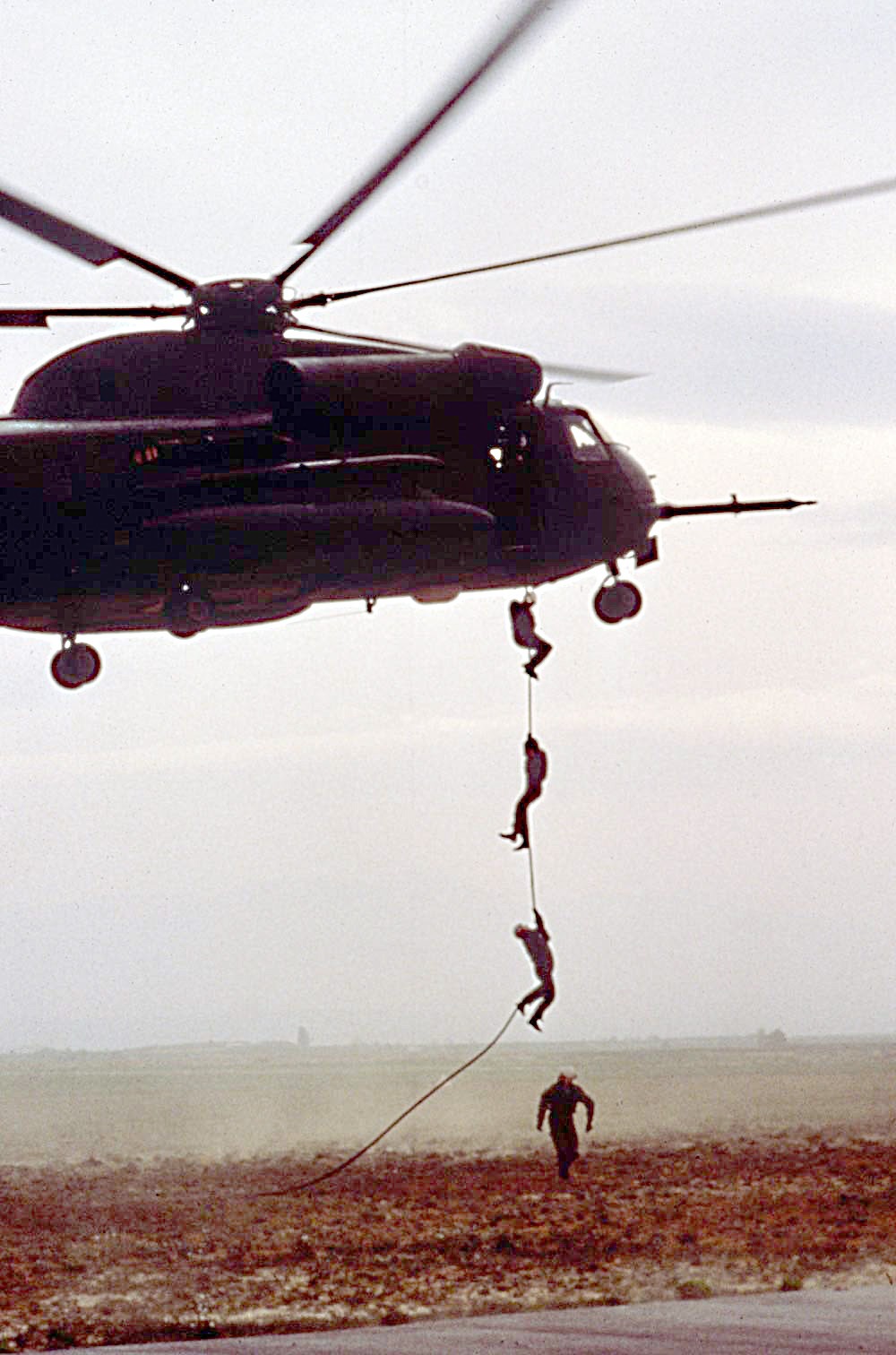
Pararescuemen do a “fast rope” from a hovering HH-53. The HH-53 Super Jolly Green Giant helicopter was used extensively during the Vietnam War for special operations and rescue of combat personnel. During past space programs, the HH-53 was on duty at the launch site as the primary astronaut recovery vehicle. Under the Air Force’s Pave Low IIIE program, nine MH-53H’s and 32 HH-53s were modified for night and adverse weather operations and designated MH-53J’s. Their modifications included forward-looking infrared, inertial global positioning system, Doppler navigation systems, a terrain-following and terrain-avoidance radar, an on-board computer and integrated avionics to enable precise navigation to and from target areas. (U.S. Air Force photo by Master Sgt. Dave Nolan)
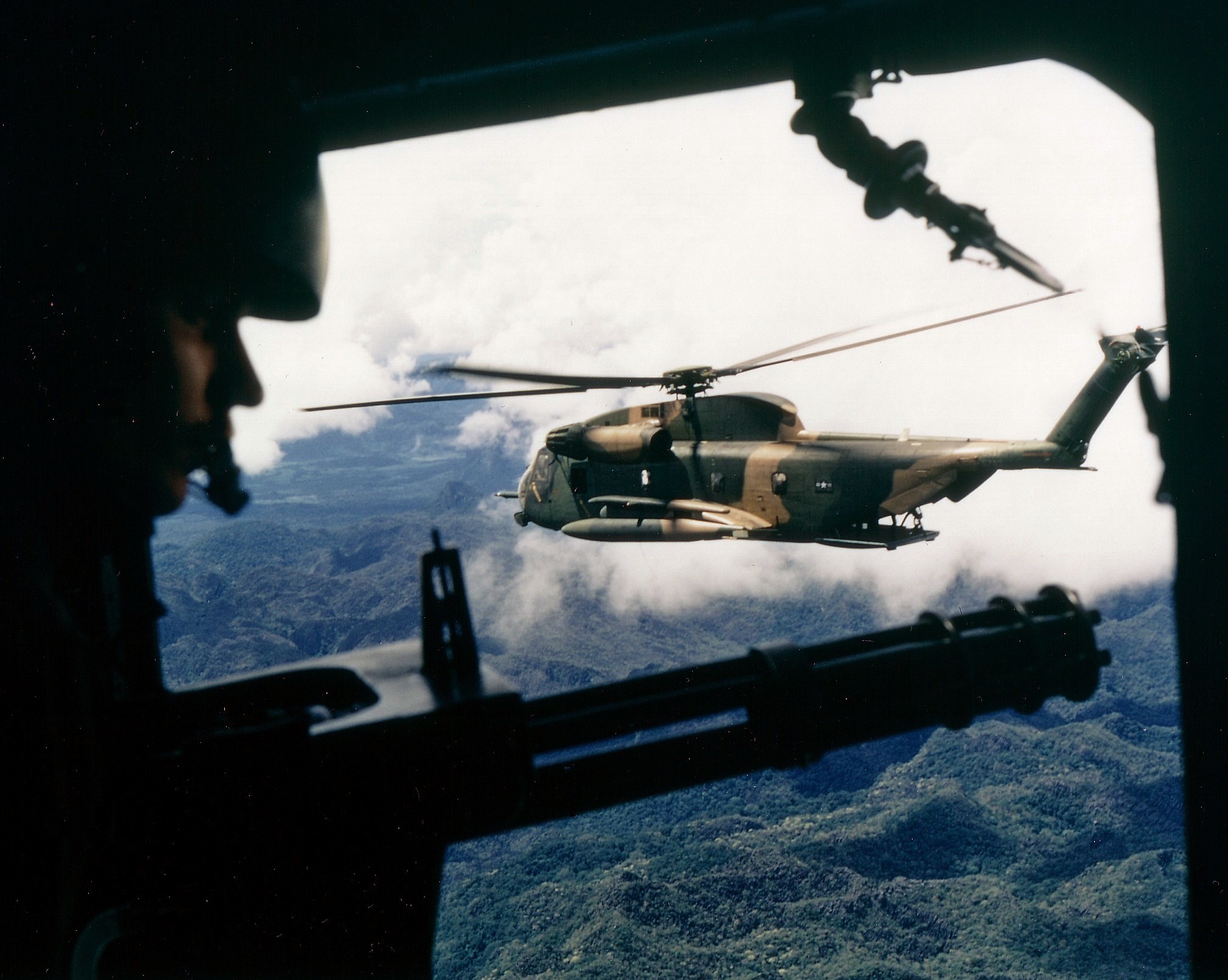
At Biên Hòa Airbase, the 37th ARRS launched two HH-53C Super Jolly Green Giant aircraft with call signs Jolly Green 70 and Jolly Green 73. The HH-53C was a specially outfitted Sikorsky S-65 helicopter, built for search, rescue, and recovery operations. Aboard Jolly Green 70 was the crew, consisting of pilot Major (Maj) Robert B. Swenck, co-pilot Captain (Capt) John W. George, Flight Engineer Sergeant (Sgt) Hank L. Theriot, and pararescuemen Staff Sergeant (SSgt) James R. Thomas, Airman 1st Class (A1C) Thomas D. Prose, and A1C Richard L. Steed.
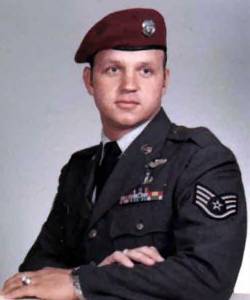
SSgt James R. Thomas, findagrave.com
The lead pararescueman on this mission, SSgt James R. Thomas, embodied the PJ motto “That Others May Live,” and was living his own dream in military service. SSgt Thomas joined the Air Force in 1961, originally as a Reciprocating Engine Mechanic. While serving with an ARRS unit, however, he came to admire the work of pararescuemen and sought out the maroon beret. Shortly after his re-enlistment in 1965, SSgt Thomas graduated from PJ school, which, according to his daughter, was “one of the happiest days of his life. He was so proud to wear the Maroon Beret which signifies the Pararescuemen, he walked around base with a big smile on his face.” SSgt Thomas excelled as a PJ and became an instructor at Eglin Air Force Base, where he participated in the launch site recoveries of eight NASA Apollo missions (7-14). Shortly after the recovery of Apollo 14 in January-February 1971, SSgt Thomas volunteered for his third tour of duty, this time deploying to Vietnam in March of 1971. When his sister Nadia asked him why he volunteered for a third tour, his answer was simple, “sis, someone has to go back and try and save those boys.”
Back in South Vietnam, Jolly Greens 70 and 73 quickly raced to the CH-46 crash site south of Cần Thơ. Poor weather in the area meant they had to fly at low altitude and in range of enemy fire. Just prior to their arrival, Army helicopters were able to rescue 7 of the 21 stranded passengers, but needed the PJs to help rescue the remainder.
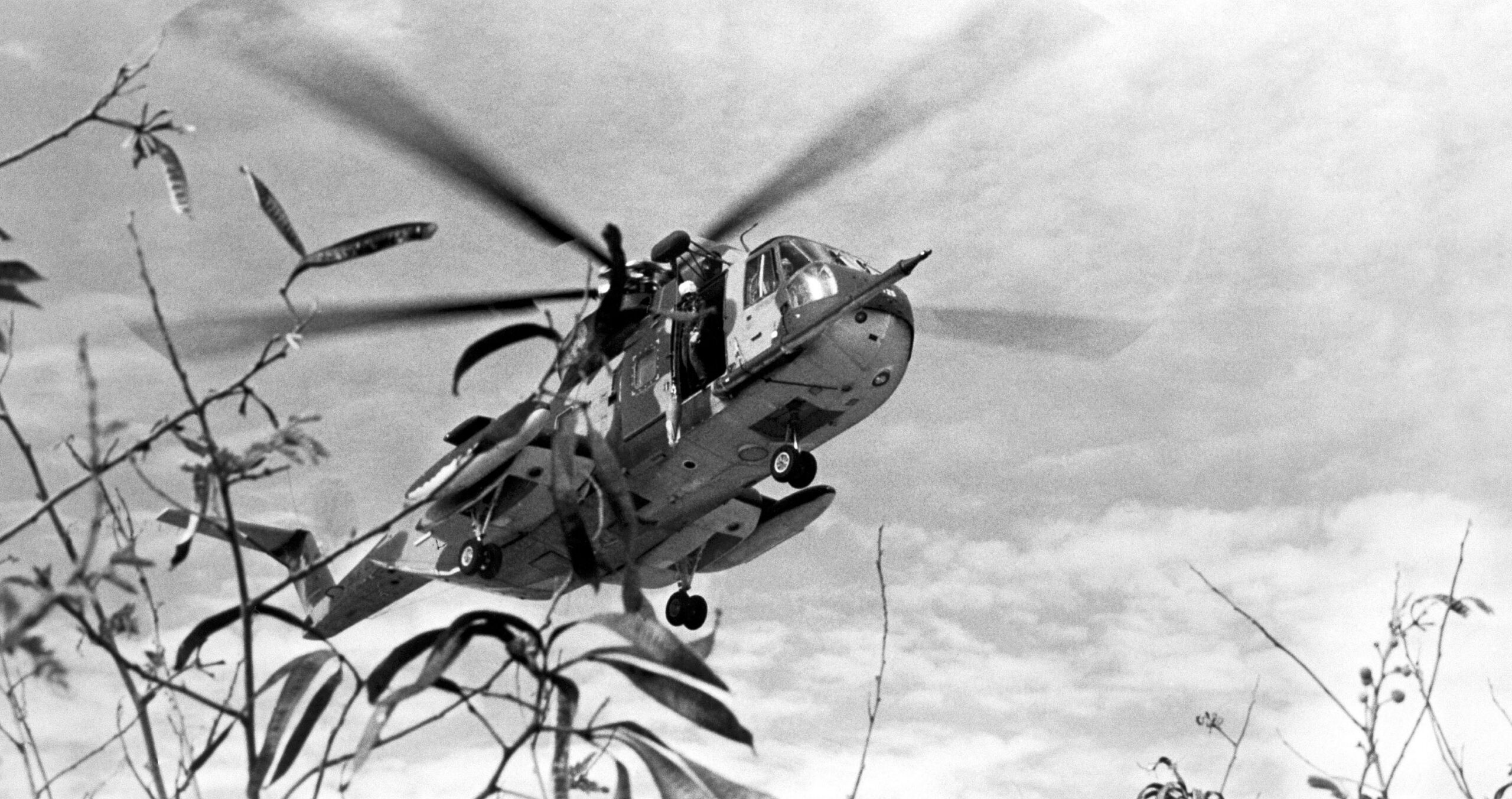
An HH-53C Super Jolly Green Giant helicopter hovers over the jungle during the rescue of a downed pilot in Southeast Asia. U.S. Air Force Photograph
Ultimately it was SSgt Thomas’s helicopter, Jolly Green 70, that took on the last 14 of the 21. Both helicopters then immediately proceeded to Bình Thủy Airbase, just a short distance away. During the rescue, Jolly Green 70 took damage from enemy small arms fire, but the helicopter successfully landed at Binh Thuy, where it offloaded the thankful passengers. While at Bình Thủy, the crew and PJs of Jolly Green 70 grabbed a Thanksgiving meal and declared their Super Jolly Green Giant safe to fly back to Biên Hòa.
The flight from Bình Thủy to Biên Hòa was routine and should have taken roughly 40 minutes. Jolly Green 70 and Jolly Green 73 took off together at 3:15 pm local for the flight back to base. On the way, Jolly Green 70 flew low bird and Jolly Green 73 flew high bird in the lead of the flight. As the flight was nearing the south of Saigon, they entered an extremely heavy rainstorm while flying low-level above the Nhà Bè River at roughly 130 mph. According to survivors, as the helicopters emerged from the rainstorm, Jolly Green 70 was actually descending toward the surface. It hit the river at full speed. Unbeknownst to the crew, the pilot, Maj Robert Swenck, had been shot by unseen enemy forces on shore. The helicopter slid across the water at first and then dug-in and flipped end-over-end, tearing apart into three sections.
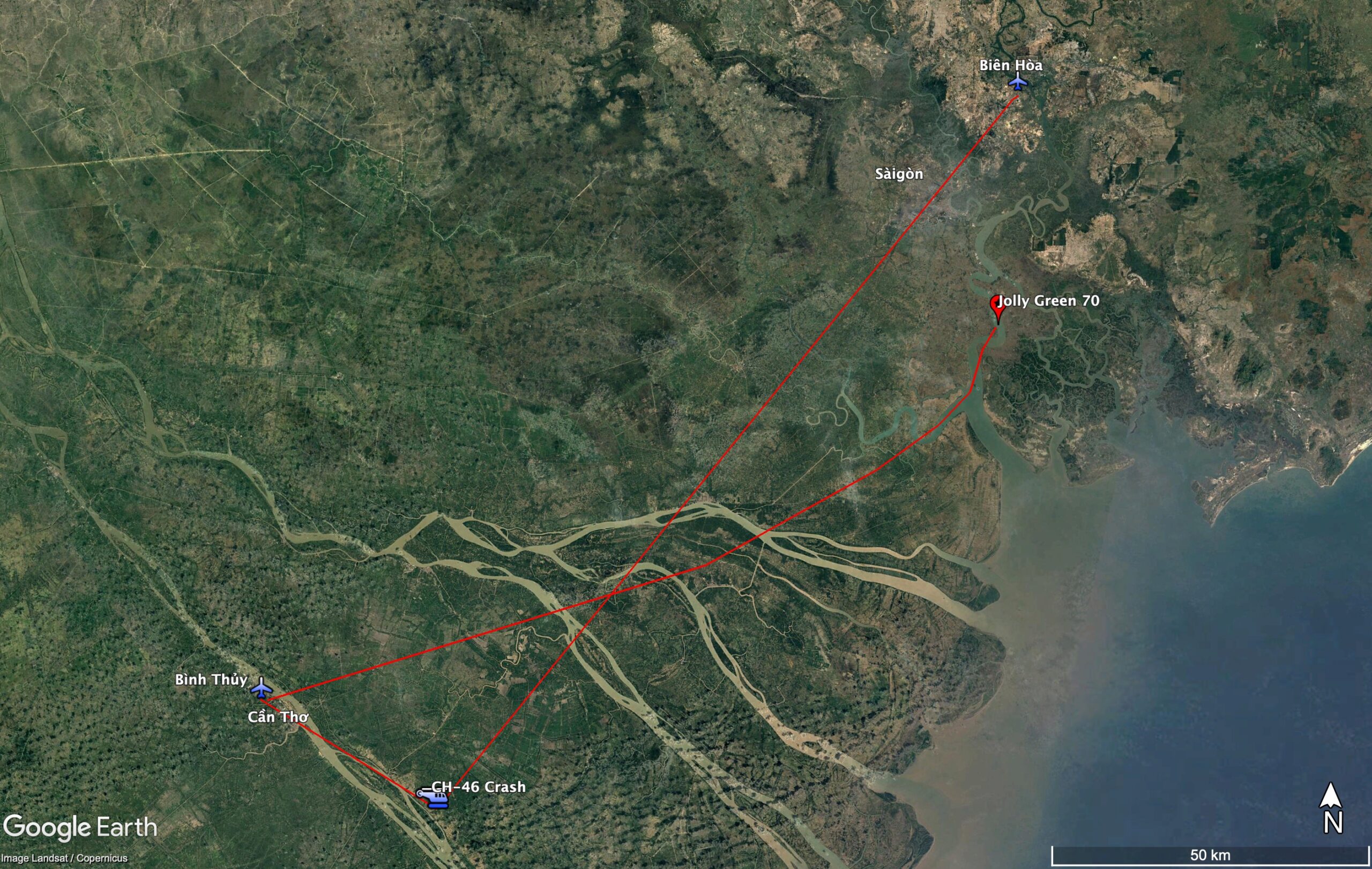
Flight path of Jolly Green 70
Several Vietnamese fishermen were in the area of the crash and witnessed the helicopter emerge from the rainstorm and hit the water, breaking apart over an area of 300 yards on the east bank of the river. In the wreckage of Jolly Green 70, Flight Engineer Sgt Hank Theriot and PJ A1C Richard Steed found themselves in a dire situation. In his statement, Sgt Theriot said “the next thing I knew I was submerged under the water with no immediate exit. After I calmed down [while trapped underwater in the wreckage of a helicopter] and realized what might have happened I started to look for a way out.” Both men were able to free themselves from the wreckage and surface in the river, but at that point they were already a quarter mile apart in a fast-moving river.
Pararesescueman A1C Steed surfaced and immediately called out to Sgt Theriot, whom he spotted down river. A1C Steed located the life raft, but found that it was leaking. In the raft, however, he did find the emergency radio and called in the mayday. As he took stock of the situation a Vietnamese fisherman approached him and pulled him from the muddy river. Meanwhile, Sgt Theriot made his way to shore and hid in the trees to avoid capture by enemy forces. Neither A1C Steed nor Sgt Theriot saw any other survivors. The Vietnamese fisherman who rescued A1C Steed, however, reported that shortly after the crash, he witnessed “three white-skinned survivors; two were holding onto the tail of the plane and the other man was by the floating cockpit.” He further stated that after rescuing A1C Steed he went back to the wreckage and found that “they had disappeared and only two berets were floating in the water.”
Both Sgt Theriot and A1C Steed were rescued within an hour of the crash. By the end of the day, the remains of the Maj Robert Swenck, Capt John George, and A1C Thomas Prose were located within the wreckage of Jolly Green 70. It was only during the autopsies that Maj Swenck’s gunshot wound was discovered.
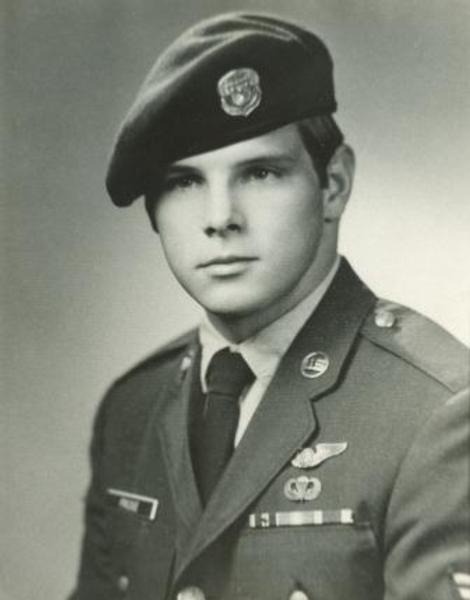
A1C Thomas Prose, findagrave.com
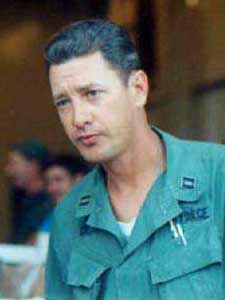
Maj Robert Swenck, findagrave.com
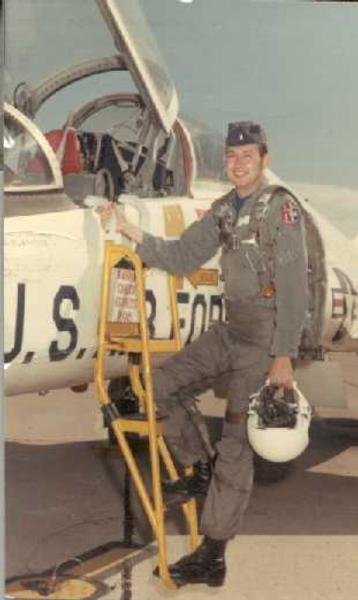
Capt John W George, findagrave.com
There was an intensive search for SSgt Thomas both in the water and on land. U.S. surface craft, divers, and Vietnamese fishermen searched the river for days using nets, grappling hooks, and even advanced handheld sonar to no avail. On 29 November, the main portion of the fuselage was raised by a crane and a diver swam through it to see if SSgt Thomas was inside, ultimately finding no evidence of his remains. Crews then tried to move the fuselage upriver so it could be pulled from the water and examined. About a mile upriver, however, the fuselage broke loose and sank in an area of the river that was 50 feet deep and had a tremendous current. It was determined at this point that the search be formally called off.
Due to the known presence of enemy forces in the area and the Vietnamese fisherman’s statement that he originally witnessed three white men at the crash site, U.S. officials declared that “it is possible that Sergeant Thomas could have also swum to shore unobserved, and was captured by hostile forces known to be in the area.” In the years since that fateful Thanksgiving Day, there have been numerous unconfirmed reports of possible American remains found by locals in the area, but nothing has yet to reveal SSgt Thomas’s fate. SSgt Thomas was posthumously promoted to Technical Sergeant and is the recipient of the Distinguished Flying Cross, the Air Medal with three Oak Leaf Clusters, and the Purple Heart.
As many of us spend time with our loved ones during this holiday season, we must continue to remember to honor the sacrifices of those military personnel who gave their lives in the service of our nation. TSgt Thomas’s Thanksgiving ended in tragedy but it was because of his heroism that 14 others lived to see the next day. Project Recover is committed to honoring TSgt Thomas’s sacrifice by continuing the search. But we need your help to do it. Every mission requires funding, expertise, and the support of people who refuse to let these heroes be forgotten.
Sources:
Author’s note: Quotes from the family members are from TSgt James Thomas’s FindaGrave.com entry. Quotes about the investigation and the witness statements are available online and open to the public at the Library of Congress (links below). Action reports for the 37th ARRS and amazing historical material from those who knew Tsgt Thomas can be found at pjhistory.org (https://pjhistory.org/KLOD/KIA/Thomas/25Nov71.pdf)
See also:
- Darrel D. Whitcomb, On a Steel Horse I Ride: A History of the MH-53 Pave Low Helicopters in War and Peace
- https://www.vvmf.org/Wall-of-Faces/51639/JAMES-R-THOMAS-2/
- https://www.findagrave.com/memorial/61477663/james_richard-thomas
- https://dpaa-mil.sites.crmforce.mil/dpaaProfile?id=a0Jt00000001UYhEAM
- https://www.loc.gov/collections/vietnam-era-pow-mia-database/?fa=subject_name:thomas,+james+r.

Enjoyed reading about these heroes… thanks for keeping their story alive
Never forget…..